-1.jpg)
Blogs
Mar 16, 2026 10:34:41 AM
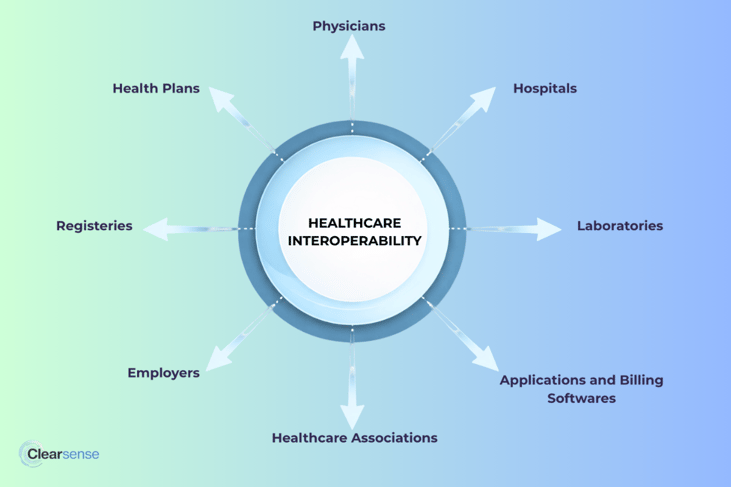
Healthcare interoperability sits at the center of modern care delivery. While most healthcare organizations have digitized records, data often remains locked inside disconnected systems. The challenge is no longer collecting information, but ensuring it can be shared, understood, and used securely and meaningfully across care settings.
Today, patient data is fragmented across electronic health records, laboratories, imaging systems, pharmacies, and payer platforms. Even with near-universal EHR adoption, clinicians frequently lack a complete view of a patient’s history. This fragmentation slows clinical decisions, increases administrative burden, and raises the risk of errors, particularly when patients receive care from multiple providers or across regions.
Healthcare interoperability addresses this gap. It refers to the ability of different health information systems to exchange, interpret, and apply data in a coordinated way. Organizations such as HIMSS emphasize that interoperability is not just about moving data between systems, but about making information usable at the point of care. This guide explores interoperability end-to-end, what it is, how it works, where it breaks down, and how healthcare leaders can move toward connected, data-driven care.
Key Takeaways
-
Only ~43% of U.S. hospitals consistently send, receive, find, and integrate patient data across systems.
-
Interoperable data exchange has improved from ~46% in 2018 to ~70% in 2023, but full clinical integration remains limited.
-
Up to 20-25% of patient records contain errors, often due to fragmented, poorly connected systems.
-
Over 80% of clinicians report that limited interoperability hinders data sharing and may compromise patient safety.
-
EHR adoption exceeds 95%, but true interoperability depends on standards, governance, and workflow integration, not on technology alone.
What Is Interoperability and Why Does It Matter?
Interoperability is the ability of health information systems to work together across organizational, technical, and semantic boundaries. It requires not just connection, but shared standards, consistent terminology, and agreed governance. According to HIMSS, true interoperability includes four core elements: data access, data exchange, data integration, and cooperative use.
Access ensures that authorized clinicians, patients, and caregivers can retrieve health information when needed. Exchange enables systems to send and receive data across care settings reliably. Integration combines information from multiple sources into a coherent, usable view. Cooperative use ensures that shared data can meaningfully support clinical decisions, operational workflows, and health policy objectives.
The Office of the National Coordinator for Health Information Technology emphasizes that interoperability is essential for delivering safe, effective, and patient-centered care while improving information access for individuals and caregivers.
Why Interoperability Matters
Over the past decade, the adoption of electronic health records has increased rapidly across healthcare systems. However, widespread digitization has not consistently translated into effective data sharing. National assessments show that many hospitals still struggle to exchange patient information outside their immediate networks, limiting care coordination and continuity.
Poor interoperability has tangible consequences. Diagnostic tests are often repeated because prior results are unavailable at the point of care. Patients are asked to carry records between providers. Public health agencies also face data blind spots during outbreaks, when fragmented systems prevent timely aggregation and analysis of information.
In response, governments worldwide have introduced policy frameworks to accelerate interoperability. In the United States, the 21st Century Cures Act established expectations for open data access and prohibited information blocking. These policies reflect a growing consensus that interoperability is essential for digital healthcare systems to deliver safe, efficient, and coordinated care.
Levels of Interoperability
Interoperability maturity is often described through four levels, with each level building on the previous one, helping organizations understand where they are today and what remains ahead:
-
Foundational interoperability enables basic data exchange between systems.
-
Structural (syntactic) interoperability defines the format and structure of exchanged data.
-
Semantic interoperability ensures shared meaning, so data can be interpreted consistently.
Organizational interoperability addresses governance, trust, policy, and legal alignment.
The first three levels focus primarily on technical and data standards. The fourth shifts attention to collaboration, incentives, and shared responsibility.
Progress Across the Levels
Foundational and structural interoperability have improved steadily over the past decade. National incentive programs and the widespread adoption of standards, such as HL7 FHIR, have made it easier for healthcare systems to exchange records and transmit data in consistent formats.
Semantic interoperability remains more challenging to achieve. Differences in clinical terminology, coding systems, and documentation practices continue to limit consistent interpretation of shared data across organizations.
Organizational interoperability presents additional challenges. Effective data sharing requires legal agreements, governance models, and shared trust frameworks. Initiatives such as the Trusted Exchange Framework and Common Agreement are designed to address these needs, but adoption and alignment across regions are still evolving.
Benefits of Interoperability
Interoperability delivers measurable benefits across clinical care, operations, patient engagement, and research. By enabling consistent data exchange and shared understanding across systems, it improves safety, coordination, efficiency, and insight generation. These benefits extend from individual patient encounters to population-level health management and evidence-based decision-making.
Faster, Safer Care
When clinicians have timely access to standardized patient data, decisions are faster and safer. A study published in the British Medical Journal shows that over 80% of clinicians report that limited interoperability negatively affects information sharing and may compromise patient safety. During emergencies or disasters, shared records reduce delays and prevent dangerous knowledge gaps. Structured data also lowers the risk of medical errors and reduces unnecessary repeat testing.
Improved Chronic Disease Management
Chronic care depends on coordination. Interoperability connects primary care providers, specialists, and patients into a shared care plan. Data from home monitoring devices, labs, and medications can flow into a unified record, enabling proactive interventions and better long-term outcomes.
Reduced Physician Burden and Costs
Administrative burden remains a major challenge in healthcare delivery. According to national estimates, clinicians spend nearly half of their workday on documentation and EHR administrative tasks, much of it due to fragmented systems. Interoperability helps streamline referrals, reporting, and prior authorization, reducing duplication and operational inefficiency. Organizations benefit from operational efficiencies, while patients face fewer redundant services and lower out-of-pocket costs.
Enhanced Patient Experience and Engagement
Interoperability improves patient access to health information and engagement in care decisions. Federal data shows that patients are significantly more likely to use portals and share data when records are complete and accessible across providers. Access to unified records improves trust, safety, and adherence.
Population Health and Research
At scale, interoperable data supports public health surveillance, population health management, and research. Standardized datasets enable comparative effectiveness studies, predictive modeling, and responsible use of AI. Without consistent data, these initiatives stall.
Interoperability Challenges
Interoperability faces persistent challenges rooted in fragmented data, privacy and security requirements, organizational resistance, high costs, inconsistent standards, and poor usability. While technology has advanced, aligning systems, incentives, governance, and workflows remains difficult. Overcoming these barriers requires coordinated technical, regulatory, and cultural efforts across healthcare organizations.
Fragmented, Inconsistent Data
Healthcare data fragmentation remains a major barrier to interoperability. Studies estimate that patient matching error rates range from 8% to over 20% when records are exchanged across organizations, leading to incomplete or duplicated patient histories. These inconsistencies make it difficult to construct a reliable longitudinal record without data normalization.
Privacy and Security Concerns
Health information is highly sensitive and must be protected at every stage of exchange. Organizations are required to comply with privacy regulations such as HIPAA while enabling appropriate access. A key challenge is verifying legitimate data requests while preventing unauthorized use or accidental disclosure.
Organizational Resistance and Information Blocking
Behavioral and economic factors also limit data sharing. Federal reporting indicates that nearly 1 in 3 healthcare organizations has experienced information blocking practices, often tied to competitive concerns or workflow disruption. Policies under the 21st Century Cures Act aim to limit information blocking and promote cooperation, but resistance remains.
Cost and Resource Constraints
Interoperability investments remain uneven across the healthcare system. Research shows that rural hospitals are approximately 30% less likely to participate in interoperable data exchange compared with urban counterparts, largely due to limited funding and workforce capacity. Infrastructure, integration, and staffing costs remain key barriers.
Lack of Standardization and Semantic Alignment
Semantic interoperability is limited when organizations use different coding systems and local terminologies. These variations prevent shared data from being interpreted consistently. Adopting standard vocabularies such as SNOMED CT and LOINC, along with normalization tools, is essential for preserving meaning across systems.
User Experience and Workflow Issues
Even well-designed interoperability solutions can fail if they disrupt clinical workflows. Clinicians are less likely to adopt systems with clunky interfaces or added documentation burden. User-centered design, adequate training, and visible leadership support are critical to ensure interoperable tools are accepted and used effectively.
Building an Interoperable Ecosystem
Building an interoperable ecosystem requires aligning technical standards, governance frameworks, and organizational practices. It depends on consistent data exchange, shared trust models, and scalable infrastructure. When these elements work together, healthcare systems can move beyond isolated data silos toward reliable, system-wide connectivity and coordinated care delivery.
Standards and Specifications
Standards and specifications form the technical foundation of interoperability. They define how health data is structured, exchanged, and interpreted across systems. Without shared standards, data cannot be reliably reused or understood. Consistent specifications enable scalable exchange, reduce integration complexity, and support meaningful use across diverse healthcare environments.
HL7® FHIR® and Messaging Standards
FHIR builds on earlier standards such as HL7 v2 and CDA to support modern, API-based data exchange. Its RESTful architecture enables flexible, real-time access to health data. As a result, FHIR has become central to national and global interoperability strategies.
Coding and Terminology Standards
Standard vocabularies such as SNOMED CT, LOINC, ICD, and CPT ensure shared clinical meaning across systems. Mapping local codes to these standards is essential for semantic interoperability. Datasets like the U.S. Core Data for Interoperability further define consistent data elements.
Governance Frameworks
Technical standards alone are insufficient for large-scale exchange. Governance frameworks such as the Trusted Exchange Framework and Common Agreement establish legal, security, and trust requirements for nationwide data sharing. Legal and policy alignment ensures interoperability functions reliably across organizational and regional boundaries.
Electronic Health Record Integration
The Role of EHR Vendors
EHR vendors vary widely in their implementation of interoperability standards. Organizations should evaluate vendor support for open APIs, standards compliance, and long-term interoperability roadmaps. These factors directly affect data accessibility, integration flexibility, and the ability to exchange information beyond closed networks.
Third-Party Integration Platforms
Integration platforms aggregate data from multiple clinical and operational systems, normalize it, and expose it through standardized APIs. Centralized architectures, including data lakehouse models, can replace fragmented legacy pipelines and accelerate analytics, reporting, and cross-organizational data exchange at scale.
Semantic Interoperability and Data Quality
Semantic interoperability depends on strong data governance and consistent data entry practices. Mapping data to standardized vocabularies preserves meaning across systems. Emerging approaches include AI-driven natural language processing and collaborative models, such as OHDSI and openEHR, to improve data structure and data reuse.
Innovative Platforms and Solutions
Clearsense: Data Enablement for Healthcare
Modern data platforms increasingly focus on enabling interoperability through centralized architectures. Clearsense provides capabilities such as active archiving, integrated data feeds, and a healthcare-focused data lakehouse designed to support standards-based exchange and analytics. These features illustrate how consolidation and normalization can reduce complexity and improve access to trusted data.
Other Data Platforms
Vendors such as Redox, InterSystems, and Health Catalyst address different aspects of interoperability, from communication layers to identity management and analytics. Evaluating platforms requires attention to scalability, standards support, and security compliance.
Strategies to Advance Interoperability
Advancing interoperability requires coordinated action across governance, standards, infrastructure, data quality, user experience, and organizational culture. Healthcare organizations must align policies, technology, and incentives to support consistent data exchange. Sustainable progress depends on leadership commitment, scalable systems, and practical workflows that make interoperability usable in everyday care.
1. Establish Governance and Policies
Organizations should form cross-functional interoperability governance committees. These groups define policies for data sharing, consent, privacy, and regulatory alignment. Transparent governance ensures consistent decision-making and supports participation in national trust frameworks such as TEFCA.
2. Adopt and Harmonize Standards
Adopting FHIR APIs and mapping local codes to standard vocabularies improves data consistency and exchange. Organizations should also use data normalization tools and participate in regional or national health information exchanges to extend interoperability beyond internal systems.
3. Invest in Scalable, Flexible Infrastructure
API-driven, cloud-native infrastructure enables organizations to scale interoperability capabilities over time. Platforms such as data lakehouses consolidate clinical and operational data, supporting analytics, population health initiatives, and cross-system data sharing without relying on brittle point-to-point integrations.
4. Focus on Data Quality and Semantics
High-quality data is foundational to interoperability. Organizations should implement programs that ensure accuracy, completeness, and consistency. Engaging subject-matter experts and using terminology services helps maintain semantic alignment as standards evolve and new data sources are introduced.
5. Prioritize User Experience
Interoperability succeeds only when clinicians can efficiently use shared data. Interfaces should integrate external data directly into workflows without increasing documentation burden. Ongoing training, support, and feedback loops are essential to drive adoption and sustained clinical use.
6. Align Incentives and Foster Culture Change
Aligning financial, regulatory, and operational incentives encourages data sharing and reduces resistance. Leadership communication and recognition of interoperability efforts help embed collaboration into organizational culture, shifting interoperability from a compliance task to a strategic priority.
Conclusion
Interoperability is essential to modern healthcare. It enables safer care, lowers costs, supports research, and empowers patients. Yet progress remains uneven, shaped by technical, organizational, and cultural challenges. Advancing interoperability requires coordinated effort across standards, infrastructure, governance, and human factors. Healthcare leaders who move beyond compliance and invest in meaningful data connections position their organizations to deliver truly data-driven, patient-centered care.
FAQs
How does interoperability affect data ownership and patient consent?
Interoperability does not change data ownership, but it increases the importance of clear consent management. Patients retain rights over their health information, while organizations must ensure data sharing aligns with consent preferences, legal requirements, and transparency expectations across connected systems.
What role do patients play in advancing healthcare interoperability?
Patients are increasingly driving interoperability through portals, apps, and data-sharing tools. When individuals actively access, share, and verify their records, they expose data gaps and inconsistencies. This engagement encourages organizations to improve exchange capabilities and prioritize patient-centered data access.
How does interoperability impact healthcare equity and access?
Interoperability can reduce health disparities by improving data continuity across care settings. When information follows patients across providers and regions, underserved populations face fewer care gaps. However, equity gains depend on inclusive system design and addressing digital access barriers.
Can interoperability support value-based care and payment models?
Interoperability is foundational to value-based care. Shared, standardized data enables outcome tracking, risk stratification, and performance measurement across providers. Without interoperable data, value-based contracts struggle to measure quality accurately or align incentives around coordinated, cost-effective care delivery.
What are the most significant risks of poor interoperability over the next decade?
Without progress, poor interoperability risks higher costs, clinician burnout, patient safety issues, and stalled innovation. Fragmented data limits AI's effectiveness, weakens public health responses, and prevents healthcare systems from effectively scaling personalized and preventive care models.
Sources
-
National Library of Medicine. Healthcare Interoperability.
https://pmc.ncbi.nlm.nih.gov/articles/PMC9875417/ -
Healthcare Information and Management Systems Society (HIMSS). What Is Healthcare Interoperability?
https://nationalcapitalarea.himss.org/resources/interoperability-healthcare -
Office of the National Coordinator for Health Information Technology (ONC). Connecting Health and Care for the Nation: A Shared Nationwide Interoperability Roadmap.
https://www.healthit.gov/topic/interoperability -
Vest JR, Kash BA. Differing Strategies to Meet Information-Sharing Needs: Publicly Supported Community Health Information Exchanges Versus Health Systems’ Enterprise Health Information Exchanges. Milbank Quarterly. 2016;94(1):77–108.
https://www.ncbi.nlm.nih.gov/pmc/articles/PMC4765934/ -
Office of the National Coordinator for Health Information Technology (ONC). 21st Century Cures Act: Interoperability, Information Blocking, and the ONC Health IT Certification Program. Federal Register. March 4, 2019. https://www.federalregister.gov/documents/2019/03/04/2019-02224/21st-century-cures-act-interoperability-information-blocking-and-the-onc-health-it-certification
-
Office of the National Coordinator for Health Information Technology (ONC). What Is FHIR? Fact Sheet. April 2021.
https://www.healthit.gov/sites/default/files/page/2021-04/What%20Is%20FHIR%20Fact%20Sheet.pdf -
Office of the National Coordinator for Health Information Technology (ONC). Trusted Exchange Framework and Common Agreement (TEFCA).
https://www.healthit.gov/topic/interoperability/policy/trusted-exchange-framework-and-common-agreement-tefca -
National Library of Medicine (PubMed Central). Health Information Technology Interoperability and Patient Safety.
https://pmc.ncbi.nlm.nih.gov/articles/PMC9523524/ -
World Health Organization Collaborating Authors. Interoperability and Digital Health for Chronic Disease Management.
International Journal of Environmental Research and Public Health. 2025;22(10):1535.
https://www.mdpi.com/1660-4601/22/10/1535 -
Vest JR, Kern LM, Silver MD, Kaushal R. The Impact of Health Information Sharing on Duplicate Testing. American Journal of Managed Care. 2015.
https://www.researchgate.net/publication/320885257_The_Impact_of_Health_Information_Sharing_on_Duplicate_Testing -
Benson T, Grieve G. Principles of Health Interoperability: SNOMED CT, HL7, and FHIR. Springer International Publishing; 2016. https://link.springer.com/book/10.1007/978-3-319-30370-3
-
Office of the National Coordinator for Health Information Technology (ONC). What Is FHIR? Fact Sheet. April 2021.
https://www.healthit.gov/sites/default/files/page/2021-04/What%20Is%20FHIR%20Fact%20Sheet.pdf -
Office of the National Coordinator for Health Information Technology (ONC). Trusted Exchange Framework and Common Agreement (TEFCA).
https://www.healthit.gov/topic/interoperability/policy/trusted-exchange-framework-and-common-agreement-tefca -
Office of the National Coordinator for Health Information Technology (ONC). Interoperability Policy and Programs.
https://www.healthit.gov/topic/interoperability/policy -
Sinsky et al., Annals of Internal Medicine. Allocation of Physician Time in Ambulatory Practice. https://www.acpjournals.org/doi/10.7326/M16-0961
-
AHIMA Journal. Keys to Help Solve Patient Data Matching. Explores patient matching challenges, error rates, and data quality issues affecting interoperability and longitudinal records. https://journal.ahima.org/Portals/0/archives/AHIMA%20files/Keys%20to%20Help%20Solve%20Patient%20Data%20Matching.pdf
-
Office of the National Coordinator for Health IT (ONC). Individuals’ Access and Use of Patient Portals and Smartphone Health Apps (2022). Provides national data on patient access, portal usage, and digital engagement trends related to interoperability.
https://www.healthit.gov/data/data-briefs/individuals-access-and-use-patient-portals-and-smartphone-health-apps-2022 -
Office of the National Coordinator for Health IT (ONC). Interoperability and Methods of Exchange Among U.S. Hospitals (2023). Analyzes hospital participation in interoperable data exchange, exchange methods, and remaining gaps.
https://www.healthit.gov/sites/default/files/2023-01/DB64_Interop_and_Methods_of_Exchange_Among_Hosp.pdf